

Blog
Cock Ring Size Guide: How to Measure and Choose the Right Fit

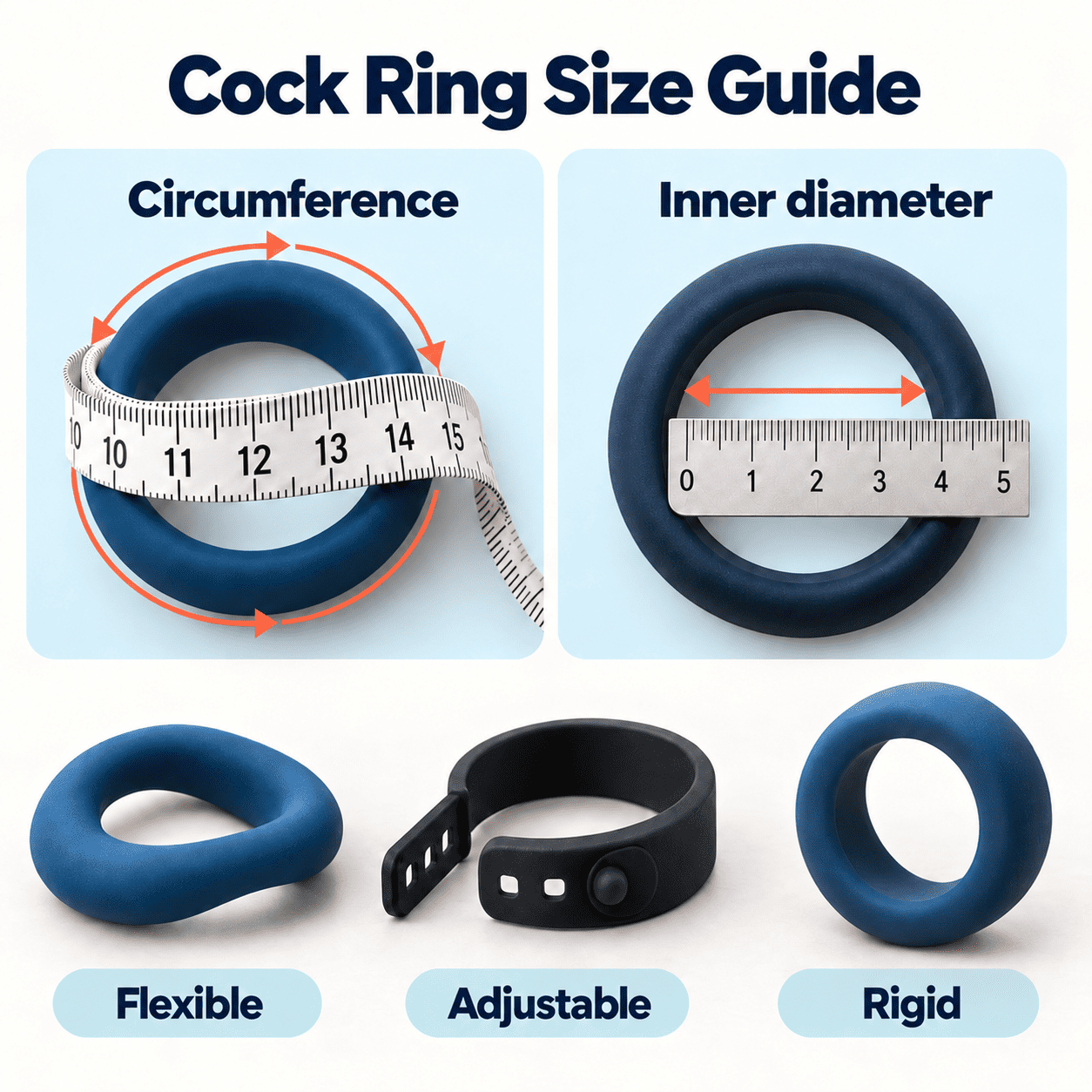
Cock ring sizing starts with circumference, not penis length. Measure around the area where the ring is designed to sit, then compare that measurement with the manufacturer’s sizing instructions. Some listings show an inner diameter, while others provide an adjustable or recommended circumference range.
A comfortable fit should never involve pain, numbness, coldness, unusual discoloration, or difficulty removing the ring. Flexible, adjustable, and rigid designs also have different fitting requirements, so there is no single universal cock ring size chart.
What Measurement Do You Need for a Cock Ring?
The most important measurement is circumference (girth) at the intended placement area.
For a penis-only ring, this generally means the circumference around the base of the shaft. A ring designed to go around both the penis and scrotum requires a different measurement, following the manufacturer’s instructions.
You can use a flexible measuring tape or a strip of soft paper and a ruler.
- Check the product instructions to identify the correct placement and measurement method.
- Measure in the state specified by the manufacturer, without pulling the tape tightly into the skin.
- Record the circumference in centimeters, millimeters, or inches.
- Compare your measurement with the product’s stated size range, opening dimensions, and fitting instructions.
Do not use penis length to determine ring size. Length does not establish the circumference required for a comfortable fit.
Cock Ring Circumference vs. Diameter
Circumference and diameter describe different measurements.
- Circumference: The distance around a circular opening.
- Diameter: The distance across the circle through its center.
- Inner diameter: The measurement across the inside opening of a ring.
For a circle, the conversion is:
Diameter = Circumference ÷ π (approximately 3.1416)
For example, a measured circumference of 12 cm is mathematically equivalent to a circular diameter of approximately 38.2 mm.
This does not mean a ring with a 38.2 mm inner diameter is automatically a safe or suitable purchase. An unstretched silicone opening, a rigid ring, and an adjustable strap can behave very differently.
Cock Ring Circumference-to-Diameter Conversion Chart
| Measured circumference | Equivalent circular diameter |
|---|---|
| 10 cm / 100 mm | 31.8 mm |
| 11 cm / 110 mm | 35.0 mm |
| 12 cm / 120 mm | 38.2 mm |
| 13 cm / 130 mm | 41.4 mm |
| 14 cm / 140 mm | 44.6 mm |
| 15 cm / 150 mm | 47.7 mm |
Important: This is a geometry reference, not a recommended cock ring size chart. It does not account for elasticity, band thickness, pressure, shape, or the manufacturer’s intended fit.
Cock Ring Size Calculator
Enter a circumference measurement below to see its equivalent circular diameter in millimeters and inches.
Cock Ring Size Calculator
Enter your measured circumference to calculate its equivalent circular diameter.
How to Read Cock Ring Sizes on Product Listings
Different brands describe ring sizes in different ways. Before choosing a product, identify what its measurements actually refer to.
| Listing detail | What it means | What to check |
|---|---|---|
| Inner diameter | Distance across the inside opening | Whether the measurement is taken at rest and whether the ring stretches |
| Inner circumference | Distance around the inside opening | Whether it describes the resting opening or a recommended fit range |
| Adjustable range | Range allowed by a strap, loop, or closure | Whether the product can be released quickly and comfortably |
| Stretch range | Manufacturer-stated expansion or fit range | Material limitations and the recommended measurement method |
| Outer diameter | Distance across the outside of the ring | Do not confuse it with the usable inner opening |
| Band width | Width of the ring material against the body | How the design distributes contact and pressure |

A listing that only says "one size fits most" may not provide enough information to evaluate fit, especially for a rigid design.
If the opening dimensions or fitting method are unclear, ask the seller or manufacturer before purchasing.
Penis-Only vs. Penis-and-Scrotum Rings
The intended placement changes which measurement matters.
| Ring format | Intended placement | Sizing consideration |
|---|---|---|
| Penis-only ring | Around the base of the shaft | Base circumference and the manufacturer's fit range |
| Penis-and-scrotum ring | Around the penis and behind the testicles | A separate measurement method for the combined placement |
| Adjustable ring | Depends on the strap or closure design | Adjustment range and quick-release mechanism |
| Rigid ring | Fixed opening specified by the manufacturer | Exact inner dimensions and safe removal |

Do not use a penis-only circumference measurement to choose a penis-and-scrotum ring. The placement and required opening are different.
Stretchy, Adjustable, or Rigid: Which Is Easier to Size?
Stretchy Rings
Flexible silicone or elastomer rings can accommodate some variation in circumference, but their stretch is not unlimited.
Check whether the product lists a recommended circumference range, a resting inner diameter, or both. A smaller unstretched opening is not automatically a better fit.
Adjustable Rings
Adjustable rings use straps, clasps, loops, or other mechanisms to change the opening.
They may be more forgiving when the exact fit is uncertain, provided the adjustment range is appropriate and the closure can be released promptly.
Rigid Rings
Rigid rings do not expand to accommodate swelling or changes in fit. Their exact opening dimensions and removal requirements are particularly important.
If you cannot confidently determine the correct size, choose a flexible or quick-release alternative rather than guessing with a fixed opening.
How Tight Should a Cock Ring Be?
A cock ring should remain in place without causing pain, excessive pressure, or changes in normal sensation.
Warning signs include:
- Numbness or tingling
- Coldness
- Unusual darkening or other concerning color changes
- Significant swelling
- Pain or pinching
- Difficulty urinating
- Difficulty removing the ring
Remove the ring immediately if any warning sign occurs. Do not continue using it to test whether the discomfort will improve.
A tighter ring is not necessarily more effective or safer. Fit should never be treated as a test of endurance.
Where Should a Cock Ring Sit?
Most basic penis-only rings are designed to sit around the base of the shaft. Other models are specifically constructed to fit around both the penis and scrotum.
These placements are not interchangeable.
Follow the manufacturer's directions for the particular design. Never force a rigid ring into place or rely on excessive pressure to make a poorly sized product fit.
How Long Can You Wear a Cock Ring?
Planned Parenthood's sex-toy guidance advises removing penis rings within 10 to 30 minutes, and sooner if pain or discomfort develops.
Treat 30 minutes as an upper limit, not a goal. Follow any shorter limit provided by the manufacturer or your healthcare professional.
Remove the ring immediately if you notice numbness, coldness, significant swelling, unusual discoloration, or pain.
If the ring becomes stuck or cannot be removed promptly, seek urgent medical care. Do not wait for severe swelling or attempt a risky removal procedure at home.
People with circulation problems, bleeding or clotting disorders, reduced sensation, or those taking anticoagulant medication should consult a qualified clinician before using a constriction-style ring.
Common Cock Ring Sizing Mistakes
Some of the most avoidable problems come from misunderstanding product dimensions rather than measuring incorrectly.
- Measuring length instead of circumference. Shaft length does not determine the ring opening.
- Confusing diameter with circumference. A 40 mm diameter is not the same as a 40 mm circumference.
- Treating a conversion chart as a fit recommendation. Geometry alone cannot predict pressure or safety.
- Using the wrong placement measurement. Penis-only and penis-and-scrotum rings require different sizing approaches.
- Assuming every silicone ring stretches the same way. Material formulation and construction vary.
- Choosing a rigid ring without a reliable sizing method. A fixed opening offers little room for error.
- Ignoring removal and time limits. A ring that initially feels comfortable can become difficult to remove.
Frequently Asked Questions
How do I know what cock ring size to buy?
Measure the circumference at the placement specified by the manufacturer. Compare it with the product's recommended fit range and opening dimensions. If the listing is unclear, contact the seller rather than guessing.
How do I convert cock ring circumference to diameter?
Divide the circumference by π (approximately 3.1416). If your circumference is in centimeters, multiply the result by 10 to express the diameter in millimeters.
For example, 12 cm ÷ 3.1416 is approximately 3.82 cm, or 38.2 mm.
This is a mathematical conversion, not a recommended ring size.
What if I am between two cock ring sizes?
Check the manufacturer's guidance. A flexible or adjustable design with a quick-release mechanism may be easier to evaluate than a rigid ring. Do not assume that choosing the smaller size is better.
Are cock rings one size fits all?
No. Some flexible or adjustable models cover a wider range of measurements, but that does not make them universally suitable. Rigid rings are especially dependent on exact dimensions.
Can a cock ring be too tight?
Yes. Pain, numbness, coldness, swelling, unusual color changes, or difficulty removing the ring are signs that it should be taken off immediately.
Is a larger cock ring always safer?
No. An oversized ring may not remain in its intended position, while an undersized ring may create excessive pressure. Safe use depends on the product design, intended placement, material, removal method, and individual health considerations.
Should I use the same size for a penis-and-scrotum ring?
No. Follow the measurement instructions for that specific configuration. A shaft-only measurement does not represent the circumference required for a ring designed to surround both areas.
The Bottom Line
A useful cock ring size guide starts with the correct measurement, but it should not end with a number on a chart.
Know where the ring is designed to sit, understand whether the listing uses circumference or diameter, and pay attention to flexibility and removal. A mathematical size conversion is not a substitute for the manufacturer's fit and safety instructions.
Explore Cock Ring and Male Sex Toy Options
FutaDoll's male sex toys includes different product formats. If you're shopping for a cock ring, look for clear opening dimensions, material information, and a practical removal method before considering additional features.
